


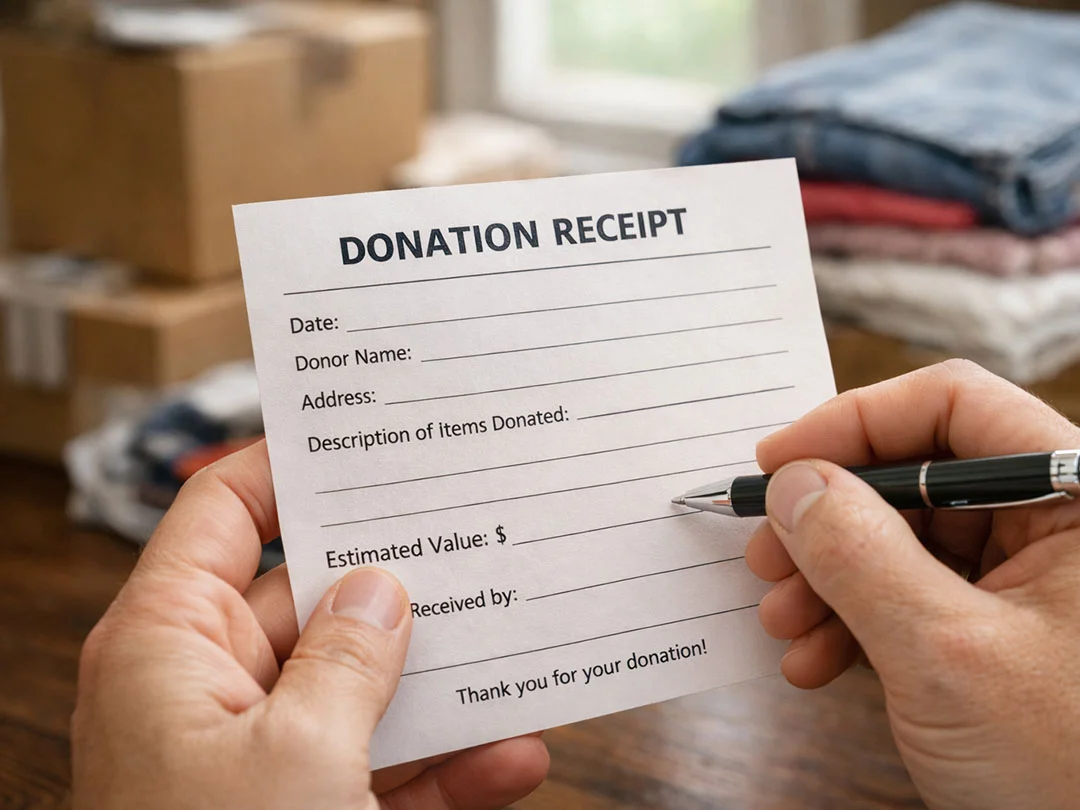
So you cleaned out the garage and dropped a bunch of stuff at a charity, and now tax season rolls around, and you are staring at a pile of receipts, wondering what you actually need to keep. You are not alone. Many people in Chicago, IL, donate clothes, furniture, and household items every year and then miss out on the tax deduction because they do not receive the proper documentation. Donation receipt tax rules aren’t as complex as they seem, but you must know what the IRS wants. This guide walks you through exactly what you need, from fair market value to written acknowledgment letters, so you can claim your deduction with confidence.
What Is a Donation Tax Receipt and Why Do You Need One
A donation tax receipt is the written proof that you gave something to a qualified nonprofit organization. Without it, the IRS can reject your deduction during an audit. The receipt documents what you gave, when you gave it, and in some cases, what it was worth. For cash donations under $250, you can usually get away with a bank statement or a canceled check. But for non-cash donated goods, the requirements become a little more involved, and that is where many donors run into trouble.
The charity itself has to be a 501(c)(3) organization recognized by the IRS. You can check this information on the IRS website using the Tax Exempt Organization Search tool. If you donate to a group that is not officially recognized, your deduction is gone, no matter how good the cause is. Churches, Goodwill, the Salvation Army, Habitat for Humanity ReStores, and similar charities in the Chicago, IL area all qualify. Smaller community groups may or may not, so it is worth checking before you assume.
Fair Market Value: What It Means and How to Figure It Out
Fair market value is the price a willing buyer would pay a willing seller when neither is pressured to complete the transaction. In plain language, it is roughly what you would get if you sold the item at a garage sale or on Facebook Marketplace. Fair market value is not the original purchase price, nor is it a random figure you choose arbitrarily.
The IRS is pretty clear that donors are responsible for determining fair market value for donated goods. For clothing and household items, a good reference is the Salvation Army’s valuation guide, which lists estimated values for common items like sofas, jackets, pots and pans, and electronics. Thrift store pricing in your area is another valid benchmark. Items in poor condition are worth less, sometimes a lot less. A worn-out couch donated to a Chicago thrift store is not worth as much as a gently used one from a home in Lincoln Park or Wicker Park, where everything has been well-maintained.
Overvaluing donated goods is a common mistake. The IRS has seen enough inflated deductions that they pay close attention to large noncash donation claims. If you are donating a significant amount, like a full household of furniture or a vehicle, be conservative and document your reasoning. If questions arise later, a few photos of the items, along with a note explaining how you arrived at the value, can be very helpful.
Documentation Requirements by Donation Size
The IRS breaks non-cash donation documentation into tiers based on the total value of your donations in a year. For donations valued at under $250, you need a receipt from the charity showing the organization’s name, the donation date, and a description of what you donated. No dollar amount is required on the receipt for non-cash gifts at this level, though you will need to determine the value yourself.
When your total non-cash donations for the year exceed $250 but stay under $500, you need a written acknowledgment from the charity. This goes beyond a simple receipt. It must include the organization’s name and address, the date and location of the donation, a description of the items, a statement indicating whether any goods or services were provided in exchange for the donation, and, if so, an estimate of their value. Most established charities in Chicago, IL, have standard acknowledgment letters they send out. If you haven’t received one automatically, please request it before filing.
For donations valued between $500 and $5,000, you must also file Form 8283 with your tax return. This form asks for information about the donated property, including how you acquired it, what you paid for it, and how you determined its fair market value. A tax professional in the River North or Near North Side area can help you fill the form out correctly if the donation is on the larger side. For donated property valued above $5,000, you generally need a qualified appraisal from a certified appraiser, and that appraiser has to sign Part III of Form 8283.
Donation Pickup Service in Chicago, IL
If you have a lot to donate and are not sure how to handle the logistics, a donation pickup service in Chicago, IL, can make the process easier. Instead of loading up your car and driving across town, a pickup crew comes to you, takes the items, and handles the transport to the qualifying charity. This is especially helpful for large furniture, appliances, and estates where there is simply too much to move on your own.
When you use a pickup service, make sure to obtain a receipt or acknowledgment letter from the charity that is actually receiving the goods. The pickup company handles the logistics, but the documentation comes from the nonprofit. Inquire upfront about the charities the service collaborates with and whether they can verify the organizations’ IRS qualification. A reputable service will have no problem answering that question. Neighborhoods like Pilsen, Logan Square, Bridgeport, and Hyde Park all have residents who regularly donate large amounts of household goods, and pickup services save a lot of time and effort when the volume is high.
Common Donation Categories and What the IRS Looks For
Clothing is the most commonly donated category, and it also generates some of the most disputed deductions. The IRS requires that donated clothing be in good used condition or better. Items in poor condition generally have no deductible value. Clothing in good shape, like name-brand coats, suits, or children’s clothes that still have wear left, can carry real value. Use the Salvation Army guide or local thrift pricing as your baseline, and do not exaggerate the condition.
Furniture and household goods follow similar rules. A dining room set in good condition from a home in Oak Park or Evanston is worth more than a scratched-up set with missing parts. Appliances need to be in working condition to carry any deductible value at all. Electronics are tricky because they depreciate fast. An older laptop or TV may have very little market value even if it still works. The Orland Park Best Buy resale market or local Facebook Marketplace listings can help you find realistic comparables for tech items.
We handle books, art, collectibles, and jewelry differently. If market comparisons do not readily establish the value of these items, even for smaller amounts, a professional appraisal may be necessary. If you are donating a large collection of books or a piece of art, do your research before assuming a high value. And if you are donating a car, boat, or aircraft, there are entirely separate rules involving Form 1098-C that the charity has to send you before you can claim the deduction.
Keeping Your Records Organized
Good record keeping is the difference between a smooth audit and a stressful one. Keep all your donation receipts and acknowledgment letters in a dedicated folder, either physical or digital. Take photos of the items before they leave your home, especially for larger donations. Write down a brief description of each item, its condition, and how you estimated the value. If you used a price guide or marketplace comparison, save a screenshot or note the source.
The IRS generally recommends keeping tax records for three years from the date you file, but for larger donations or complex returns, some advisors suggest keeping documents longer. If you are donating regularly throughout the year, as many Chicago, IL residents do during spring, cleanouts, fall moves, or end-of-year tax planning, a simple spreadsheet can keep everything organized with little effort. Date, charity, item description, and estimated value. Four columns are all you really need.
Ready to Schedule a pick-up? We Can Help
If you have items ready to go and want to ensure they reach a qualifying charity with the proper documentation, contact us today to schedule your donation pickup. We serve Chicago, IL, and surrounding areas, and we make it easy to donate responsibly while keeping your tax records clean. Whether it is a single room or an entire home, we handle the heavy lifting so you can focus on the deduction.
Picture Source: AI-generated